home
work
about
Check my master’s final project
As a climber myself, I wanted to enhance the climbing experience through my Master’s final project. I embarked on the journey of designing a dynamic app that helps climbers seamlessly track their sessions, share their progress, and connect with a like-minded community. My goal was to create an engaging and accessible platform that makes indoor climbing more interactive and fosters a stronger sense of connection among climbers.
Type:
Master’s Final Project

Methodology:
Design Thinking

Tools:
Figma
Cateogry:
UX Research and UI Design
empathize
Problem
Currently, climbing apps face several issues: many have unintuitive interfaces, making them difficult to use; key features are often locked behind paywalls; and users need multiple apps to manage different aspects of their activity, such as maps, training, and connecting with other climbers. This results in a fragmented, confusing, and costly experience, highlighting the need for an all-in-one solution that seamlessly integrates these features into a user-friendly and accessible platform.
Outcome
My solution is Crux, an all-in-one climbing app designed to simplify and enhance the user experience. Crux features an intuitive, user-friendly interface that brings together essential functions such as personalized training plans, progress tracking, and a community of climbers—all in a single platform. With Crux, users can access these tools for free or through a fair subscription, eliminating the need for multiple apps and extra payments. This way, we provide a seamless, efficient, and accessible experience for climbers of all levels
desk research& netnography
As a climber myself, I had firsthand experience with the challenges of using different climbing apps. However, to gain a broader and more objective understanding, I combined desk research and netnography to analyze the landscape of digital tools for climbers. My desk research allowed me to explore existing solutions, industry trends, and the technological gaps in current apps. Meanwhile, through netnography, I studied online climbing communities, forums, and social media discussions to identify common frustrations, expectations, and feature requests directly from users.
Through my research, I aimed to:

Identify the main difficulties climbers face when using existing apps.
Understand how climbers interact with digital tools for training, route planning, and community engagement.
Understand how climbers interact with digital tools for training, route planning, and community engagement.
This combined approach provided a well-rounded perspective on user needs and helped me define key areas for improvement in climbing app experiences.
01
Inintuitive interfaces
Many climbing apps have cluttered or confusing designs, making it difficult for users to navigate and access key features.
02
Usability Issues
Climbers experience frustration with disorganized menus, unclear interactions, and a lack of personalization in existing apps.
03
Features Locked Behind Paywalls
Many apps restrict fundamental functions like route access and progress tracking, forcing users to pay for what they consider essential tools.
04
Fragmented Digital Experience
Users often rely on multiple apps for different needs—one for route mapping, another for training, and another for social connection—leading to a disjointed experience.
05
Technology as a Natural Extension
While climbing is a physical and social activity, digital tools have become part of the experience. The challenge lies in integrating them seamlessly without disrupting the essence of climbing.
research questions
01
What features and functionalities are most valued by climbers in a comprehensive climbing app?
02
How does the ability to connect with other climbers influence users' motivation and performance?
03
How can the app enhance the climbing experience in both indoor and outdoor environments?
04
What role does community feedback play in improving climbing techniques and strategies?
05
What methods for tracking progress and emotions are most effective in helping climbers improve their performance?
06
How can an app support rest and recovery cycles by integrating real-time stats and feedback?
07
How does personalized training planning within the app impact user outcomes?
08
How relevant is the integration of a psychological or motivational support community within the app for climbers?
benchmarking
As part of the research process, benchmarking was conducted to analyze existing climbing apps and identify industry standards, strengths, and gaps in the market. By evaluating competitors, I gained insights into best practices, common pain points, and opportunities for improvement. This comparison helped define key features, usability patterns, and differentiators that would enhance the user experience and provide a more comprehensive solution for climbers.

The application includes the described functionality but does not necessarily stand out in its implementation. In other words, it meets the basic need without offering additional features or significant improvements.

The application does not include the functionality.
Not only does the application provide the functionality, but it does so in an outstanding way, with additional features that enhance the user experience. This feature is well-designed, intuitive, and exceeds expectations.
Top loger
Bumble
Mountain Project
Redpoint
Vertical Life
Cling
27 Crags
Kaya Climb
The Crag
La Pirca
Clarity and usability of the interface
Detailed tracking of achievements and training sessions
Social features for finding climbing partners
Adaptive workout programs based on user level and goals
Physical and emotional state tracking
Active community for user interaction and knowledge sharing


The comparative analysis of existing climbing applications reveals that, while many offer interesting features such as climbing logs and training programs, none integrate all these functionalities into a single platform. Additionally, only one of the evaluated apps allows users to record mood or feelings, which could be key to a more personalized approach. Many users also report recurring issues with the user interface and the lack of an active community, limiting the app’s usefulness. This highlights a clear opportunity to develop an application that seamlessly combines these features, promoting both personal progress tracking and climber connectivity, with a strong focus on safety and community-driven motivation.
swot
needs
All-in-One Tool
Combines achievement tracking, training logs, and social features.
User-Friendly
Intuitive navigation enhances the experience.
Affordable
Free or low-cost, making it widely accessible.
Insurance Card Scanning
Builds trust by ensuring that users are responsible
Community-Driven
Encourages interaction and a sense of belonging.
Personalized Training
Tracks mood and injuries for mindful progress.
weakness
Strong Competition
Several well-established apps in the market offer similar functionalities.
Limited Resources
As a new app, it may lack the user base and content of more established competitors.
Revenue Dependence
If the app is free or low-cost, it may face financial challenges in sustaining development and long-term operations.
opportunities
Growing Interest in Climbing
Increasing popularity, especially in urban settings and climbing gyms.
Partnership Opportunities
Potential collaborations with climbing gyms to promote the app.
Technological Innovations
Integration of new technologies, such as augmented reality, to enhance the user experience.
Demand for Affordable Apps
The rising interest in climbing presents an opportunity to attract users seeking budget-friendly alternatives to expensive apps
threats
Shifting Trends
Fluctuations in climbing popularity could impact app usage
Competition from Facebook Groups
These groups are a popular way to find climbing partners, potentially reducing app engagement.
Financial Sustainability
Offering the app for free or at a low cost may risk insufficient revenue to cover operational expenses, threatening service continuity and future improvements.
qualitative research
To better understand user needs and expectations, I conducted interviews with men and women aged 20 to 40, with varying levels of climbing experience and different technology usage habits. Additionally, five of them were immigrants living in a foreign country, which allowed me to explore how climbing helps with social adaptation and building a sense of community in a new environment. These interviews provided valuable insights into their motivations, challenges, and preferences, enabling me to design a solution that truly aligns with their real needs
Number of
interviews

7
interviews have been conducted
01
Through the interviews, I identified several key pain points faced by indoor climbers. One of the main challenges is the need to use multiple apps to manage their activity, as there is currently no platform that integrates essential features like community building, climb tracking, and finding partners in one place. Additionally, many users expressed frustration over paid content restricting access to fundamental features in other climbing apps.
02
Another key finding is that 90% of interviewees believe their emotional state significantly impacts their climbing performance, highlighting the importance of having a supportive community. Additionally, several participants, especially women, mentioned that they stopped climbing due to the lack of climbing partners, emphasizing the need for a solution that facilitates connections among climbers.
03
On the other hand, all interviewees agreed that they trust climbers with a certified insurance card, considering it a key factor for safety. Lastly, they highlighted that seeing other climbers' achievements serves as a major source of motivation and learning, helping them continuously improve their skills.
quantitative research
define
user persona
empathy map
She hears about the existence of many apps for tracking training sessions, but none that fully meet her needs. Other climbers also talk about their achievements and how their routines help them improve.

hear


see

Celia talks about her training and the importance of consistency. She keeps a detailed record of her achievements as a climber and expresses her desire for an app that allows her not only to track her progress but also to share it with the community and learn from others.
Celia feels a strong passion for climbing and continuous improvement. She is committed to her progress and pushing her limits. Additionally, she wants to share her knowledge with the community and learn from other climbers.

thinks
and feels


say
and do
Celia talks about her training and the importance of consistency. She keeps a detailed record of her achievements as a climber and expresses her desire for an app that allows her not only to track her progress but also to share it with the community and learn from others.
costumer journey map
needs matrix
needs

Logging of climbing routes and achievements, both indoor and outdoor.
Social features (sharing achievements, connecting with friends).
Belayer verification to build trust within the community.
Option to log physical and mental state after sessions.
Functionality to find reliable climbing partners.
pains

Difficulty finding climbing partners in a new location.
Difficulty tracking and monitoring injuries or specific physical conditions.
Concerns about safety when climbing with strangers.
Lack of platforms that combine progress tracking with social features.
gains

Ease of maintaining a detailed and organized climbing history.
Motivation through progress tracking and friends' achievements.
Increased safety knowing that belayers are accredited.
A trustworthy environment to meet verified climbers.
Ability to monitor physical performance and avoid movements that cause pain.
finding and insights
ideate
busniess model canvas
sitemap
flowchart
low and high fidelity


name
WALL TYPE
CRUX HOLDS
attemps
not sent
sent
1
boulder
lead

ubicación
nombre
nombre
hora
hora
likes
comentarios
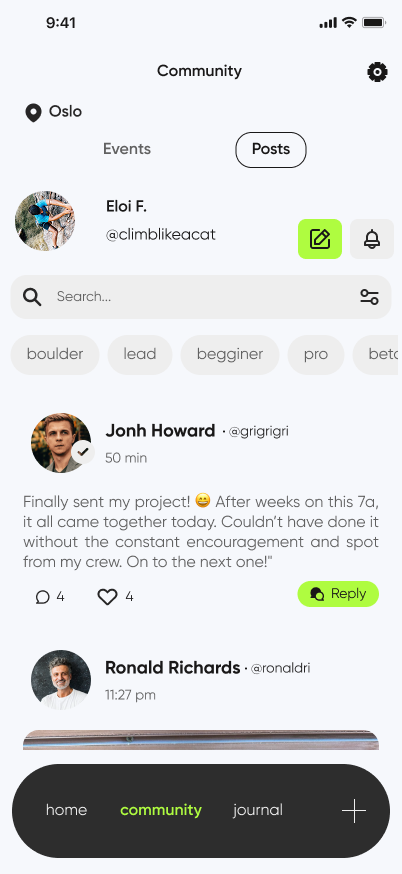
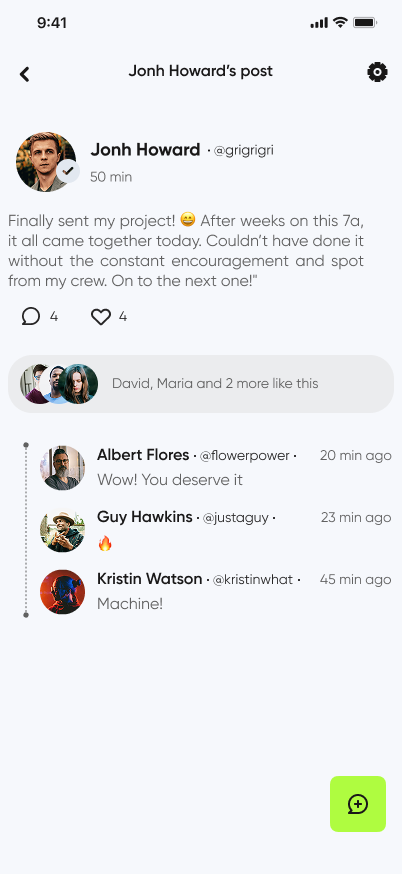
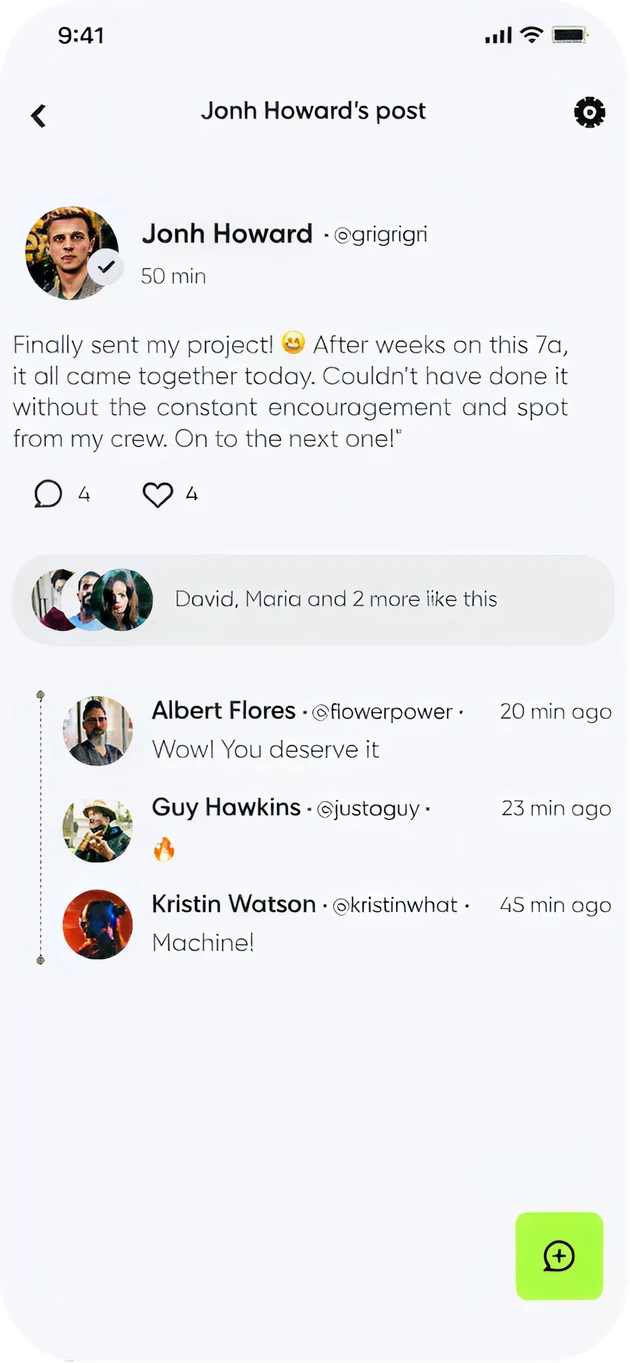
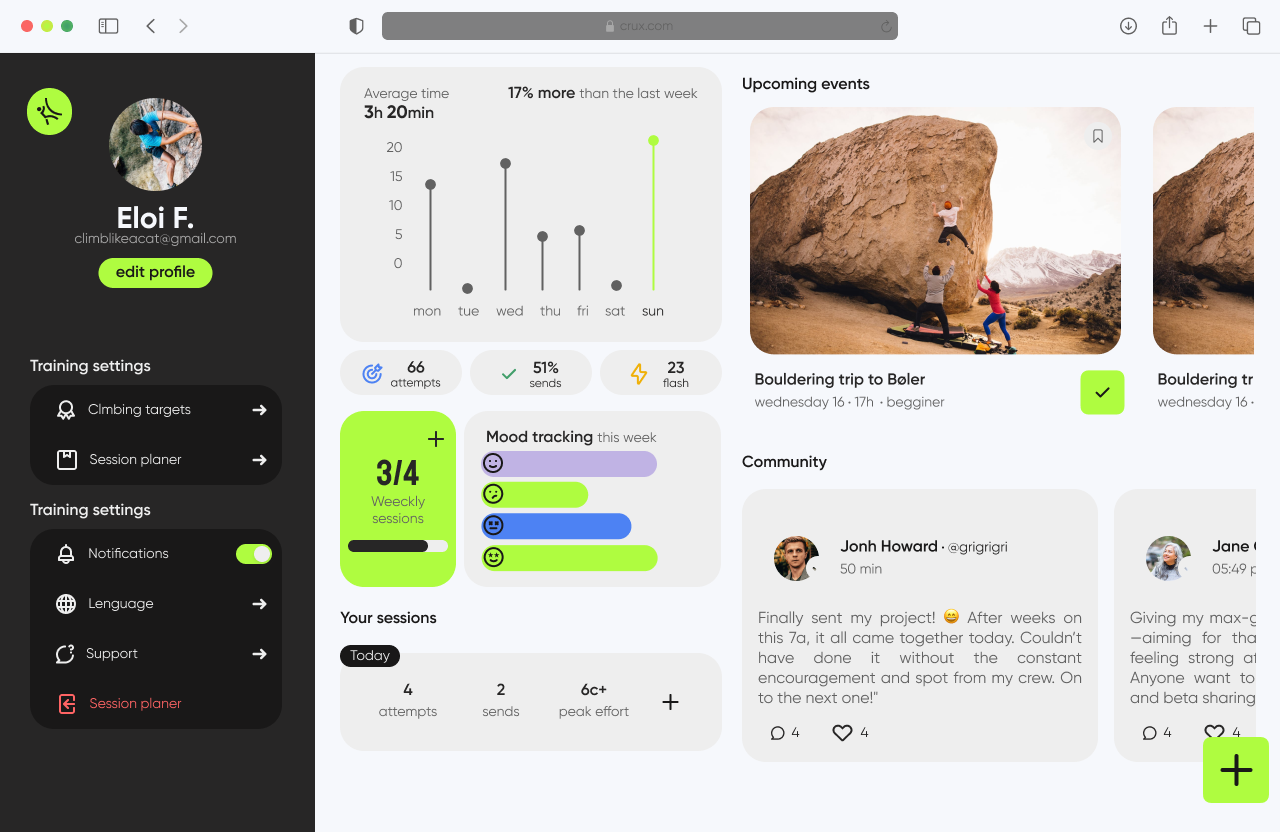
Finally sent my project! 😄 After weeks on this 7a, it all came together today. Couldn’t have done it without the constant encouragement and spot from my crew. On to the next one!"
Finally sent my project! 😄 After weeks on this 7a, it all came together today. Couldn’t have done it without the constant encouragement and spot from my crew. On to the next one!"
nueva publicación

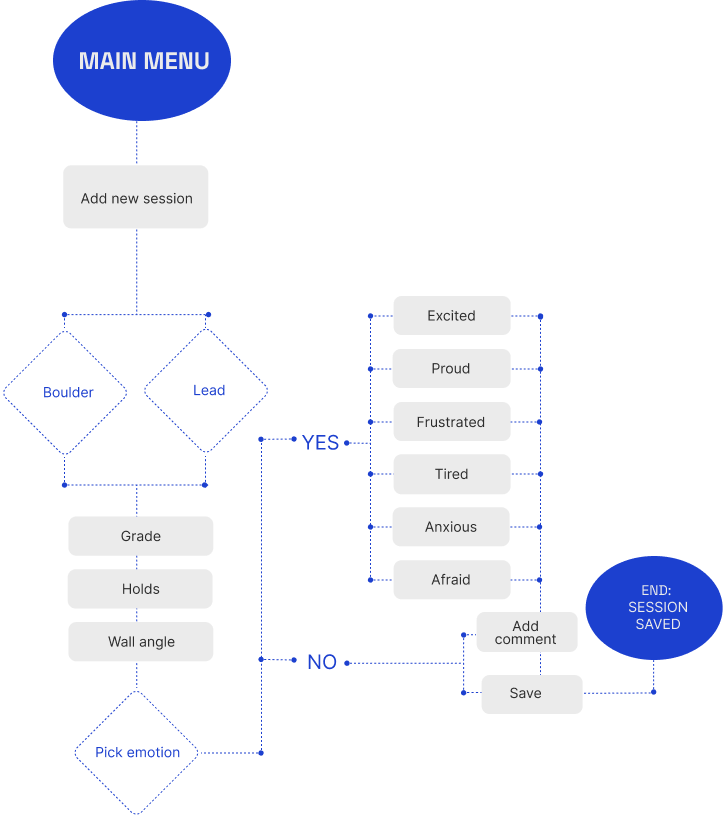
flowchart


4
columns

16
gutter


10
margin
foundation
ui kit
prototype
final ui

Place your design here


Place your design here
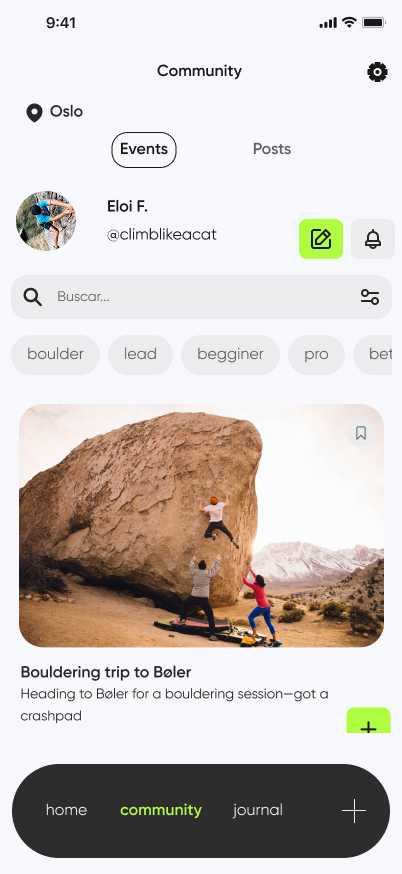
Place your design here
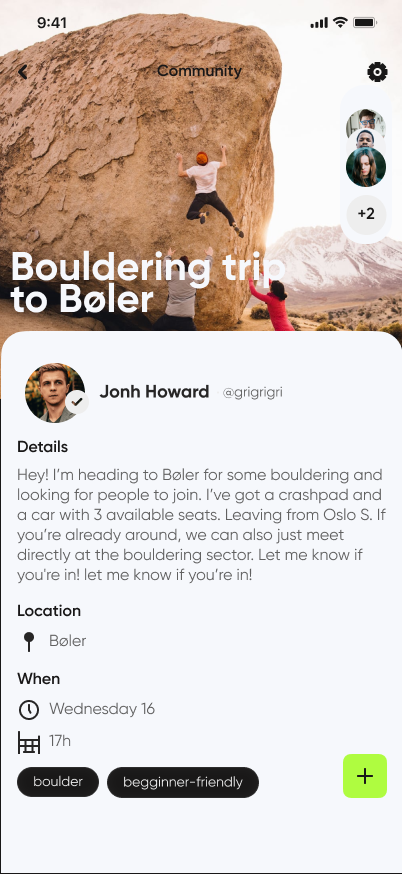
Place your design here
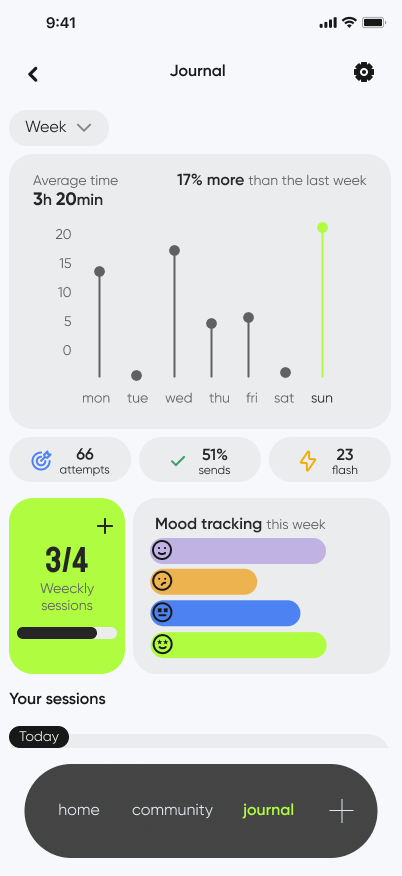


Place your design here
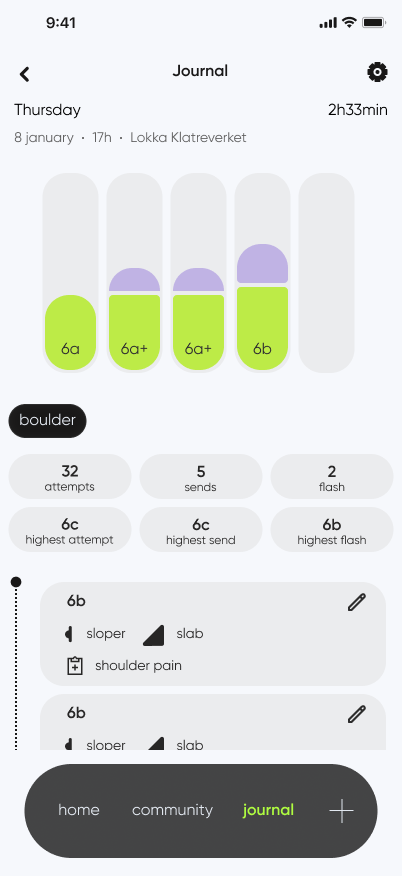


Place your design here
Place your design here


LET’S WORK TOGETHER
I’m a UX designer with a curious eye for stories and digital experiences. Looking for my first opportunity to craft designs that make life easier (and prettier). Oh, and I’m also funny and know a bunch of random fun facts. Let’s talk!
nereafcastro@gmail.com

check my CV
© 2026
Home

Work
About
Nerea Castro
home
work
about
Check my master’s final project
As a climber myself, I wanted to enhance the climbing experience through my Master’s final project. I embarked on the journey of designing a dynamic app that helps climbers seamlessly track their sessions, share their progress, and connect with a like-minded community. My goal was to create an engaging and accessible platform that makes indoor climbing more interactive and fosters a stronger sense of connection among climbers.
Type:
Master’s Final Project

Methodology:
Design Thinking

Tools:
Figma
Cateogry:
UX Research and UI Design
empathize
Problem
Currently, climbing apps face several issues: many have unintuitive interfaces, making them difficult to use; key features are often locked behind paywalls; and users need multiple apps to manage different aspects of their activity, such as maps, training, and connecting with other climbers. This results in a fragmented, confusing, and costly experience, highlighting the need for an all-in-one solution that seamlessly integrates these features into a user-friendly and accessible platform.
Outcome
My solution is Crux, an all-in-one climbing app designed to simplify and enhance the user experience. Crux features an intuitive, user-friendly interface that brings together essential functions such as personalized training plans, progress tracking, and a community of climbers—all in a single platform. With Crux, users can access these tools for free or through a fair subscription, eliminating the need for multiple apps and extra payments. This way, we provide a seamless, efficient, and accessible experience for climbers of all levels
desk research & netnography
As a climber myself, I had firsthand experience with the challenges of using different climbing apps. However, to gain a broader and more objective understanding, I combined desk research and netnography to analyze the landscape of digital tools for climbers. My desk research allowed me to explore existing solutions, industry trends, and the technological gaps in current apps. Meanwhile, through netnography, I studied online climbing communities, forums, and social media discussions to identify common frustrations, expectations, and feature requests directly from users.
Identify the main difficulties climbers face when using existing apps.
Understand how climbers interact with digital tools for training, route planning, and community engagement.
Understand how climbers interact with digital tools for training, route planning, and community engagement.
This combined approach provided a well-rounded perspective on user needs and helped me define key areas for improvement in climbing app experiences.
01
Inintuitive interfaces
Many climbing apps have cluttered or confusing designs, making it difficult for users to navigate and access key features.
02
Usability Issues
Climbers experience frustration with disorganized menus, unclear interactions, and a lack of personalization in existing apps.
03
Features Locked Behind Paywalls
Many apps restrict fundamental functions like route access and progress tracking, forcing users to pay for what they consider essential tools.
04
Fragmented Digital Experience
Users often rely on multiple apps for different needs—one for route mapping, another for training, and another for social connection—leading to a disjointed experience.
05
Technology as a Natural Extension
While climbing is a physical and social activity, digital tools have become part of the experience. The challenge lies in integrating them seamlessly without disrupting the essence of climbing.
research questions
01
What features and functionalities are most valued by climbers in a comprehensive climbing app?
02
How does the ability to connect with other climbers influence users' motivation and performance?
03
How can the app enhance the climbing experience in both indoor and outdoor environments?
04
What role does community feedback play in improving climbing techniques and strategies?
05
What methods for tracking progress and emotions are most effective in helping climbers improve their performance?
06
How can an app support rest and recovery cycles by integrating real-time stats and feedback?
07
How does personalized training planning within the app impact user outcomes?
08
How relevant is the integration of a psychological or motivational support community within the app for climbers?
benchmarking
As part of the research process, benchmarking was conducted to analyze existing climbing apps and identify industry standards, strengths, and gaps in the market. By evaluating competitors, I gained insights into best practices, common pain points, and opportunities for improvement. This comparison helped define key features, usability patterns, and differentiators that would enhance the user experience and provide a more comprehensive solution for climbers.
The application includes the described functionality but does not necessarily stand out in its implementation. In other words, it meets the basic need without offering additional features or significant improvements.

The application does not include the functionality.
Not only does the application provide the functionality, but it does so in an outstanding way, with additional features that enhance the user experience. This feature is well-designed, intuitive, and exceeds expectations.
Top loger
Bumble
Mountain Project
Redpoint
Vertical Life
Cling
27 Crags
Kaya Climb
The Crag
La Pirca
Clarity and usability of the interface
Detailed tracking of achievements and training sessions
Social features for finding climbing partners
Adaptive workout programs based on user level and goals
Physical and emotional state tracking
Active community for user interaction and knowledge sharing


The comparative analysis of existing climbing applications reveals that, while many offer interesting features such as climbing logs and training programs, none integrate all these functionalities into a single platform. Additionally, only one of the evaluated apps allows users to record mood or feelings, which could be key to a more personalized approach. Many users also report recurring issues with the user interface and the lack of an active community, limiting the app’s usefulness. This highlights a clear opportunity to develop an application that seamlessly combines these features, promoting both personal progress tracking and climber connectivity, with a strong focus on safety and community-driven motivation.
swot
needs
All-in-One Tool
Combines achievement tracking, training logs, and social features.
User-Friendly
Intuitive navigation enhances the experience.
Affordable
Free or low-cost, making it widely accessible.
Insurance Card Scanning
Builds trust by ensuring that users are responsible
Community-Driven
Encourages interaction and a sense of belonging.
Personalized Training
Tracks mood and injuries for mindful progress.
weakness
Strong Competition
Several well-established apps in the market offer similar functionalities.
Limited Resources
As a new app, it may lack the user base and content of more established competitors.
Revenue Dependence
If the app is free or low-cost, it may face financial challenges in sustaining development and long-term operations.
opportunities
Growing Interest in Climbing
Increasing popularity, especially in urban settings and climbing gyms.
Partnership Opportunities
Potential collaborations with climbing gyms to promote the app.
Technological Innovations
Integration of new technologies, such as augmented reality, to enhance the user experience.
Demand for Affordable Apps
The rising interest in climbing presents an opportunity to attract users seeking budget-friendly alternatives to expensive apps
threats
Shifting Trends
Fluctuations in climbing popularity could impact app usage
Competition from Facebook Groups
These groups are a popular way to find climbing partners, potentially reducing app engagement.
Financial Sustainability
Offering the app for free or at a low cost may risk insufficient revenue to cover operational expenses, threatening service continuity and future improvements.
qualitative research
To better understand user needs and expectations, I conducted interviews with men and women aged 20 to 40, with varying levels of climbing experience and different technology usage habits. Additionally, five of them were immigrants living in a foreign country, which allowed me to explore how climbing helps with social adaptation and building a sense of community in a new environment. These interviews provided valuable insights into their motivations, challenges, and preferences, enabling me to design a solution that truly aligns with their real needs
Number of
interviews

7
interviews have been conducted
01
Through the interviews, I identified several key pain points faced by indoor climbers. One of the main challenges is the need to use multiple apps to manage their activity, as there is currently no platform that integrates essential features like community building, climb tracking, and finding partners in one place. Additionally, many users expressed frustration over paid content restricting access to fundamental features in other climbing apps.
02
Another key finding is that 90% of interviewees believe their emotional state significantly impacts their climbing performance, highlighting the importance of having a supportive community. Additionally, several participants, especially women, mentioned that they stopped climbing due to the lack of climbing partners, emphasizing the need for a solution that facilitates connections among climbers.
03
On the other hand, all interviewees agreed that they trust climbers with a certified insurance card, considering it a key factor for safety. Lastly, they highlighted that seeing other climbers' achievements serves as a major source of motivation and learning, helping them continuously improve their skills.
quantitative research
For the quantitative research, I conducted 10 surveys, which were shared in a local climbers' Facebook group. Unlike the interviews, which included a more diverse group, these questionnaires were focused on local climbers, who placed less emphasis on meeting new climbing partners. Through this questionnaire, I gathered key insights about their habits, needs, and expectations regarding indoor climbing.
78%
of respondents expressed interest in logging their physical and emotional sensations after their climbing sessions.

98%
of respondents stated that seeing other climbers' achievements motivates them and helps them improve their performance
“Setting goals or documenting a project, planning arrangements/trips in groups and maybe joining others trips/tours etc”
define
persona
empathy map
She hears about the existence of many apps for tracking training sessions, but none that fully meet her needs. Other climbers also talk about their achievements and how their routines help them improve.

hear


see

Celia talks about her training and the importance of consistency. She keeps a detailed record of her achievements as a climber and expresses her desire for an app that allows her not only to track her progress but also to share it with the community and learn from others.
Celia feels a strong passion for climbing and continuous improvement. She is committed to her progress and pushing her limits. Additionally, she wants to share her knowledge with the community and learn from other climbers.
thinks
and feels


say
and do
Celia talks about her training and the importance of consistency. She keeps a detailed record of her achievements as a climber and expresses her desire for an app that allows her not only to track her progress but also to share it with the community and learn from others.
costumer journey map
needs matrix
needs
Logging of climbing routes and achievements, both indoor and outdoor.
Social features (sharing achievements, connecting with friends).
Belayer verification to build trust within the community.
Option to log physical and mental state after sessions.
Functionality to find reliable climbing partners.
pains
Difficulty finding climbing partners in a new location.
Difficulty tracking and monitoring injuries or specific physical conditions.
Concerns about safety when climbing with strangers.
Option to log physical and mental state after sessions.
Lack of platforms that combine progress tracking with social features.
gains
Ease of maintaining a detailed and organized climbing history.
Motivation through progress tracking and friends' achievements.
Increased safety knowing that belayers are accredited.
A trustworthy environment to meet verified climbers.
Ability to monitor physical performance and avoid movements that cause pain.
findind and insights
businiess model canvas
ideate
sitemap

CRUX
home
community
journey
profile


Change goals
Preferences
Personal information
Check climbing record
Explore and post
in the community
View, filter, search, “like”
Explore and post events
Shortcut: Add Session
Shortcut: Journey
Shortcut: Community
Shortcut: Profile


flowchart


Main menu


Grade
Add new session
Excited
Tired
Holds
Proud
Anxious
Wall angle
Add comment
Save
Frustrated
Afraid
Boulder
Pick emotion
Lead
YES
NO


End:
session saved


low and high fidelity


name
WALL TYPE
CRUX HOLDS
attemps
not sent
sent
1
boulder
lead

ubicación
nombre
nombre
hora
hora
likes
comentarios
Finally sent my project! 😄 After weeks on this 7a, it all came together today. Couldn’t have done it without the constant encouragement and spot from my crew. On to the next one!"
Finally sent my project! 😄 After weeks on this 7a, it all came together today. Couldn’t have done it without the constant encouragement and spot from my crew. On to the next one!"
nueva publicación


grid
4
columns

16
gutter


10
margin
foundation
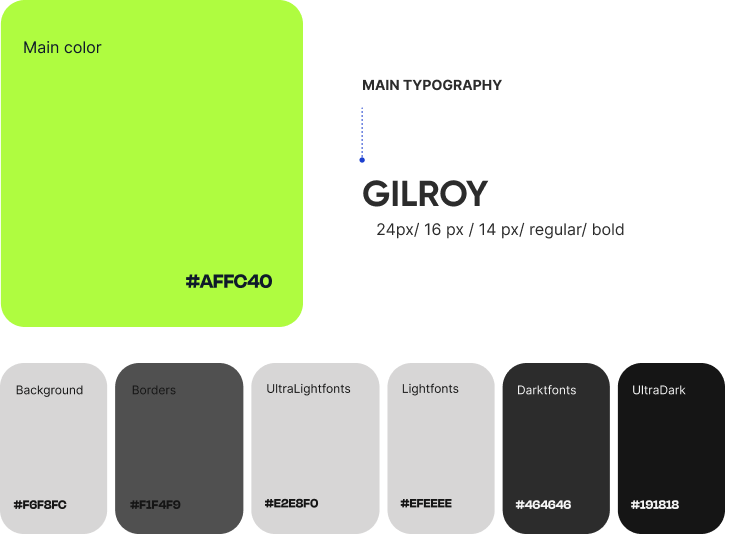
#AFFC40
Main color
Main typography

GILROY
24px/ 16 px / 14 px/ regular/ bold
#F1F4F9
Borders
#E2E8F0
UltraLightfonts
#EFEEEE
Lightfonts
#464646
Darktfonts
#191818
UltraDark
#F6F8FC
Background
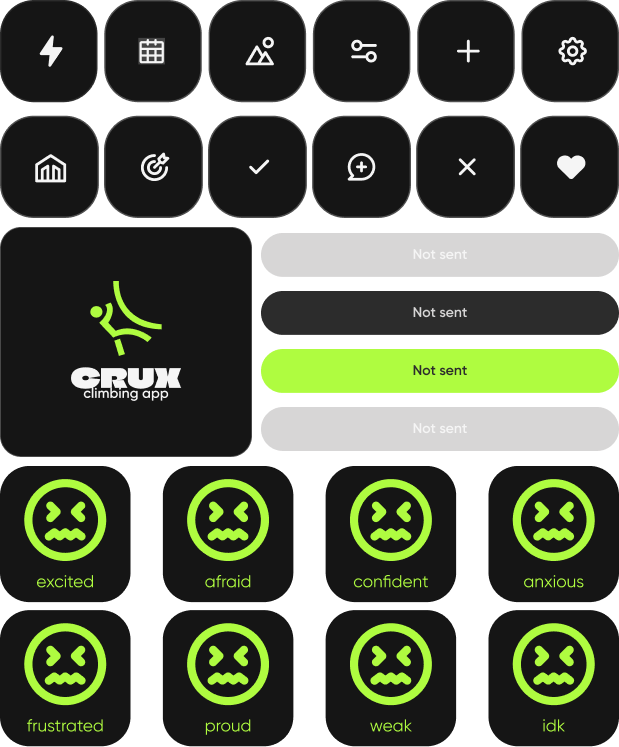
ui kit


CRUX
climbing app
Not sent
Not sent
Not sent
Not sent
excited
afraid
confident
anxious
frustrated
proud
weak
idk
prototype
final ui
Place your design here
nereafcastro@gmail.com

check my CV
I’m a UX designer with a curious eye for stories and digital experiences. Looking for my first opportunity to craft designs that make life easier (and prettier). Oh, and I’m also funny and know a bunch of random fun facts. Let’s talk!
home
work
about
Check my master’s final project
As a climber myself, I wanted to enhance the climbing experience through my Master’s final project. I embarked on the journey of designing a dynamic app that helps climbers seamlessly track their sessions, share their progress, and connect with a like-minded community. My goal was to create an engaging and accessible platform that makes indoor climbing more interactive and fosters a stronger sense of connection among climbers.
Type:
Master’s Final Project

Methodology:
Design Thinking

Tools:
Figma
Cateogry:
UX Research and UI Design
empathize

define
ideate
prototype
Problem
Currently, climbing apps face several issues: many have unintuitive interfaces, making them difficult to use; key features are often locked behind paywalls; and users need multiple apps to manage different aspects of their activity, such as maps, training, and connecting with other climbers. This results in a fragmented, confusing, and costly experience, highlighting the need for an all-in-one solution that seamlessly integrates these features into a user-friendly and accessible platform.
Outcome
My solution is Crux, an all-in-one climbing app designed to simplify and enhance the user experience. Crux features an intuitive, user-friendly interface that brings together essential functions such as personalized training plans, progress tracking, and a community of climbers—all in a single platform. With Crux, users can access these tools for free or through a fair subscription, eliminating the need for multiple apps and extra payments. This way, we provide a seamless, efficient, and accessible experience for climbers of all levels
desk research & netnography
As a climber myself, I had firsthand experience with the challenges of using different climbing apps. However, to gain a broader and more objective understanding, I combined desk research and netnography to analyze the landscape of digital tools for climbers. My desk research allowed me to explore existing solutions, industry trends, and the technological gaps in current apps. Meanwhile, through netnography, I studied online climbing communities, forums, and social media discussions to identify common frustrations, expectations, and feature requests directly from users.

Identify the main difficulties climbers face when using existing apps.
Understand how climbers interact with digital tools for training, route planning, and community engagement.
Explore which features climbers find most useful and which ones they feel are missing.
Understand how climbers interact with digital tools for training, route planning, and community engagement.
This combined approach provided a well-rounded perspective on user needs and helped me define key areas for improvement in climbing app experiences.
01
Inintuitive interfaces
Many climbing apps have cluttered or confusing designs, making it difficult for users to navigate and access key features.
02
Usability Issues
Climbers experience frustration with disorganized menus, unclear interactions, and a lack of personalization in existing apps.
03
Features Locked Behind Paywalls
Many apps restrict fundamental functions like route access and progress tracking, forcing users to pay for what they consider essential tools.
04
Fragmented Digital Experience
Users often rely on multiple apps for different needs—one for route mapping, another for training, and another for social connection—leading to a disjointed experience.
05
Technology as a Natural Extension
While climbing is a physical and social activity, digital tools have become part of the experience. The challenge lies in integrating them seamlessly without disrupting the essence of climbing.
research questions
01
What features and functionalities are most valued by climbers in a comprehensive climbing app?
03
How does the ability to connect with other climbers influence users' motivation and performance?
05
How can the app enhance the climbing experience in both indoor and outdoor environments?
07
What role does community feedback play in improving climbing techniques and strategies?
02
What methods for tracking progress and emotions are most effective in helping climbers improve their performance?
04
How can an app support rest and recovery cycles by integrating real-time stats and feedback?
06
How does personalized training planning within the app impact user outcomes?
08
How relevant is the integration of a psychological or motivational support community within the app for climbers?
benchmarking
As part of the research process, benchmarking was conducted to analyze existing climbing apps and identify industry standards, strengths, and gaps in the market. By evaluating competitors, I gained insights into best practices, common pain points, and opportunities for improvement. This comparison helped define key features, usability patterns, and differentiators that would enhance the user experience and provide a more comprehensive solution for climbers.
The application includes the described functionality but does not necessarily stand out in its implementation. In other words, it meets the basic need without offering additional features or significant improvements.


The application does not include the functionality.
Not only does the application provide the functionality, but it does so in an outstanding way, with additional features that enhance the user experience. This feature is well-designed, intuitive, and exceeds expectations.
Top loger
Bumble
Mountain Project
Redpoint
Vertical Life
Cling
27 Crags
Kaya Climb
The Crag
La Pirca
Clarity and usability of the interface
Detailed tracking of achievements and training sessions
Social features for finding climbing partners
Adaptive workout programs based on user level and goals
Physical and emotional state tracking
Active community for user interaction and knowledge sharing


The comparative analysis of existing climbing applications reveals that, while many offer interesting features such as climbing logs and training programs, none integrate all these functionalities into a single platform. Additionally, only one of the evaluated apps allows users to record mood or feelings, which could be key to a more personalized approach. Many users also report recurring issues with the user interface and the lack of an active community, limiting the app’s usefulness. This highlights a clear opportunity to develop an application that seamlessly combines these features, promoting both personal progress tracking and climber connectivity, with a strong focus on safety and community-driven motivation.
swot
needs
All-in-One Tool
Combines achievement tracking, training logs, and social features.
User-Friendly
Intuitive navigation enhances the experience.
Affordable
Free or low-cost, making it widely accessible.
Insurance Card Scanning
Builds trust by ensuring that users are responsible
Community-Driven
Encourages interaction and a sense of belonging.
Personalized Training
Tracks mood and injuries for mindful progress.
weakness
Strong Competition
Several well-established apps in the market offer similar functionalities.
Limited Resources
As a new app, it may lack the user base and content of more established competitors.
Revenue Dependence
If the app is free or low-cost, it may face financial challenges in sustaining development and long-term operations.
opportunities
Growing Interest in Climbing
Increasing popularity, especially in urban settings and climbing gyms.
Partnership Opportunities
Potential collaborations with climbing gyms to promote the app.
Technological Innovations
Integration of new technologies, such as augmented reality, to enhance the user experience.
Demand for Affordable Apps
The rising interest in climbing presents an opportunity to attract users seeking budget-friendly alternatives to expensive apps
threats
Shifting Trends
Fluctuations in climbing popularity could impact app usage
Competition from Facebook Groups
These groups are a popular way to find climbing partners, potentially reducing app engagement.
Financial Sustainability
Offering the app for free or at a low cost may risk insufficient revenue to cover operational expenses, threatening service continuity and future improvements.
qualitative research
To better understand user needs and expectations, I conducted interviews with men and women aged 20 to 40, with varying levels of climbing experience and different technology usage habits. Additionally, five of them were immigrants living in a foreign country, which allowed me to explore how climbing helps with social adaptation and building a sense of community in a new environment. These interviews provided valuable insights into their motivations, challenges, and preferences, enabling me to design a solution that truly aligns with their real needs
Number of
interviews
7
interviews have been conducted
01
Through the interviews, I identified several key pain points faced by indoor climbers. One of the main challenges is the need to use multiple apps to manage their activity, as there is currently no platform that integrates essential features like community building, climb tracking, and finding partners in one place. Additionally, many users expressed frustration over paid content restricting access to fundamental features in other climbing apps.
02
Another key finding is that 90% of interviewees believe their emotional state significantly impacts their climbing performance, highlighting the importance of having a supportive community. Additionally, several participants, especially women, mentioned that they stopped climbing due to the lack of climbing partners, emphasizing the need for a solution that facilitates connections among climbers.
03
On the other hand, all interviewees agreed that they trust climbers with a certified insurance card, considering it a key factor for safety. Lastly, they highlighted that seeing other climbers' achievements serves as a major source of motivation and learning, helping them continuously improve their skills.
quantitative research
For the quantitative research, I conducted 10 surveys, which were shared in a local climbers' Facebook group. Unlike the interviews, which included a more diverse group, these questionnaires were focused on local climbers, who placed less emphasis on meeting new climbing partners. Through this questionnaire, I gathered key insights about their habits, needs, and expectations regarding indoor climbing.
78%
of respondents expressed interest in logging their physical and emotional sensations after their climbing sessions.
98%
of respondents stated that seeing other climbers' achievements motivates them and helps them improve their performance
“Setting goals or documenting a project, planning arrangements/trips in groups and maybe joining others trips/tours etc”
empathize
define
ideate
prototype
persona
Célia Pérez, 22
Aragón, Spain

Sports Science Student
High use of technological devices., apps and social media
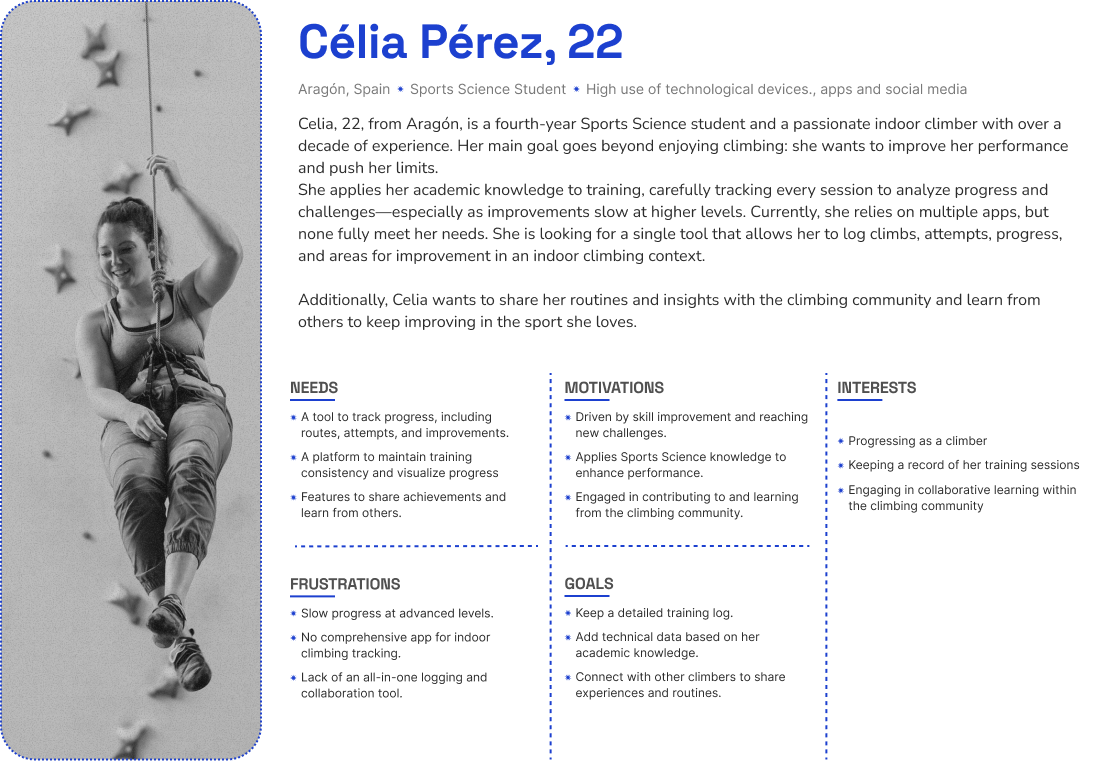
Celia, 22, from Aragón, is a fourth-year Sports Science student and a passionate indoor climber with over a decade of experience. Her main goal goes beyond enjoying climbing: she wants to improve her performance and push her limits.
She applies her academic knowledge to training, carefully tracking every session to analyze progress and challenges—especially as improvements slow at higher levels. Currently, she relies on multiple apps, but none fully meet her needs. She is looking for a single tool that allows her to log climbs, attempts, progress, and areas for improvement in an indoor climbing context.
Additionally, Celia wants to share her routines and insights with the climbing community and learn from others to keep improving in the sport she loves.
needs

A tool to track progress, including routes, attempts, and improvements.
A platform to maintain training consistency and visualize progress
Features to share achievements and learn from others.

frustrations
Slow progress at advanced levels.
No comprehensive app for indoor climbing tracking.
Lack of an all-in-one logging and collaboration tool.

motivations
Driven by skill improvement and reaching new challenges.
Applies Sports Science knowledge to enhance performance.

Engaged in contributing to and learning from the climbing community.

goals
Keep a detailed training log.
Add technical data based on her academic knowledge.
Connect with other climbers to share experiences and routines.
interests
Progressing as a climber
Keeping a record of her training sessions
Engaging in collaborative learning within the climbing community
empathy map
She hears about the existence of many apps for tracking training sessions, but none that fully meet her needs. Other climbers also talk about their achievements and how their routines help them improve.
hear


see
Celia talks about her training and the importance of consistency. She keeps a detailed record of her achievements as a climber and expresses her desire for an app that allows her not only to track her progress but also to share it with the community and learn from others.
Celia feels a strong passion for climbing and continuous improvement. She is committed to her progress and pushing her limits. Additionally, she wants to share her knowledge with the community and learn from other climbers.
thinks
and feels


say
and do
Celia talks about her training and the importance of consistency. She keeps a detailed record of her achievements as a climber and expresses her desire for an app that allows her not only to track her progress but also to share it with the community and learn from others.
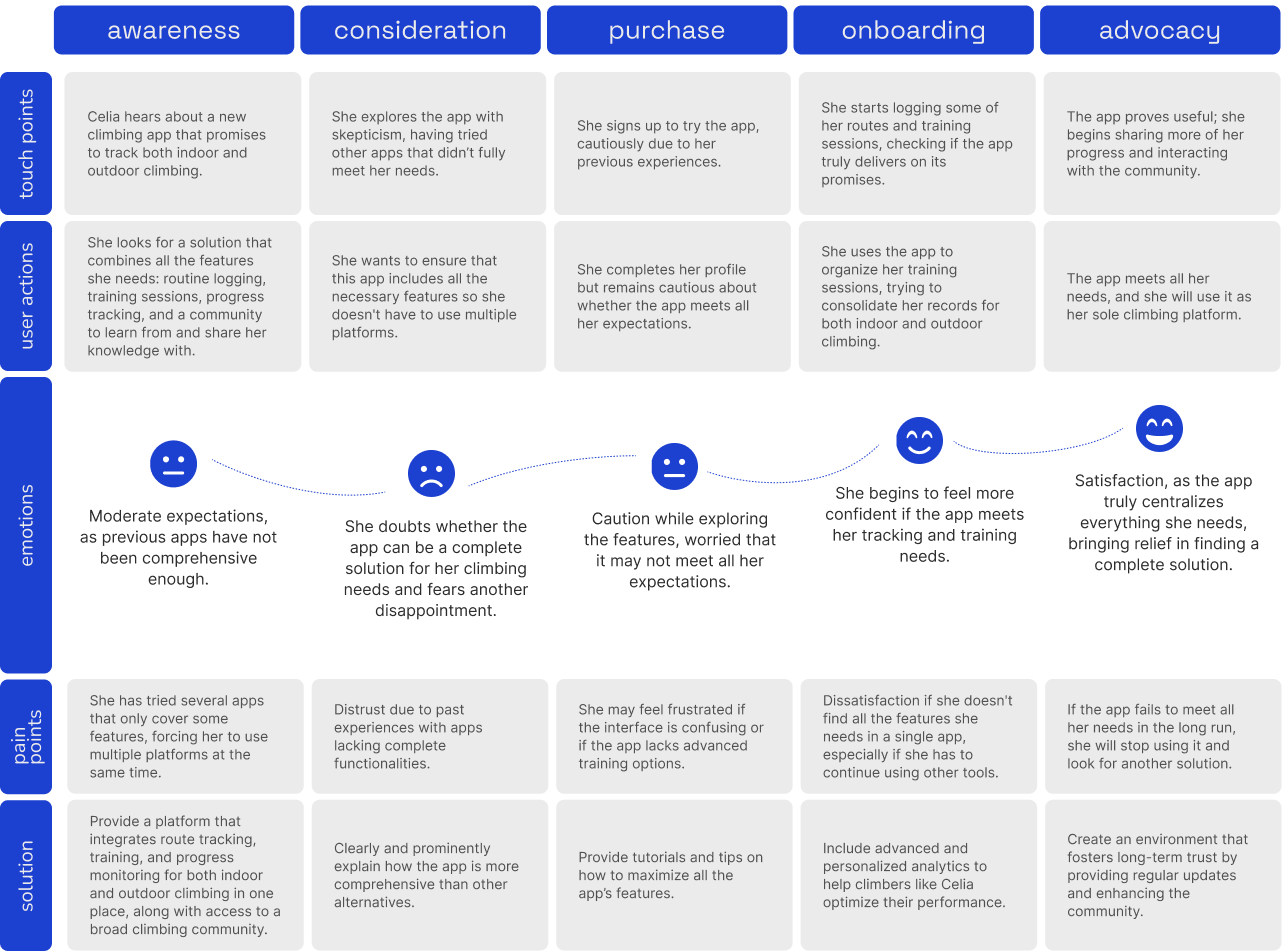
costumer journey map
needs matrix
needs
Logging of climbing routes and achievements, both indoor and outdoor.
Social features (sharing achievements, connecting with friends).
Belayer verification to build trust within the community.
Option to log physical and mental state after sessions.
Functionality to find reliable climbing partners.
pains
Difficulty finding climbing partners in a new location.
Difficulty tracking and monitoring injuries or specific physical conditions.
Concerns about safety when climbing with strangers.
Lack of platforms that combine progress tracking with social features.
gains
Ease of maintaining a detailed and organized climbing history.
Motivation through progress tracking and friends' achievements.
Increased safety knowing that belayers are accredited.
A trustworthy environment to meet verified climbers.
Ability to monitor physical performance and avoid movements that cause pain.
finding and insights
business model canvas
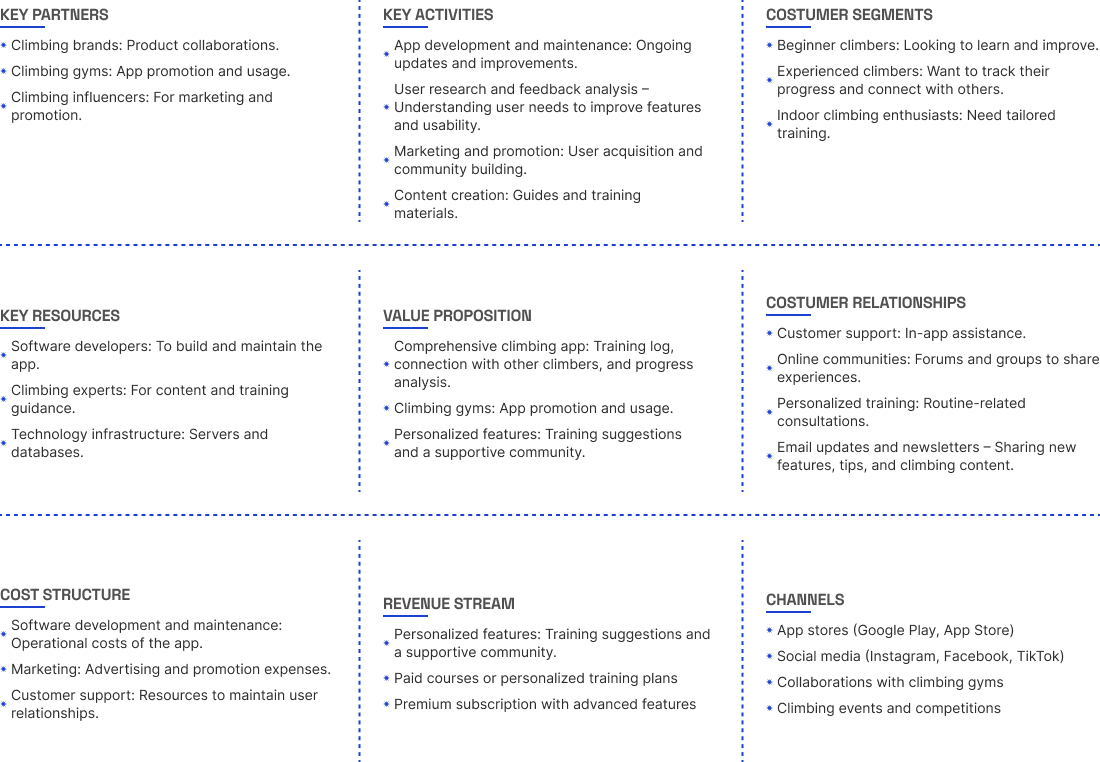
key partners
Climbing brands: Product collaborations.
Climbing gyms: App promotion and usage.
Climbing influencers: For marketing and promotion.

key activities
App development and maintenance: Ongoing updates and improvements.
User research and feedback analysis – Understanding user needs to improve features and usability.
Marketing and promotion: User acquisition and community building.
Content creation: Guides and training materials.

costumer segments
Beginner climbers: Looking to learn and improve.
Experienced climbers: Want to track their progress and connect with others.
Indoor climbing enthusiasts: Need tailored training.

key resources
Software developers: To build and maintain the app.
Climbing experts: For content and training guidance.
Technology infrastructure: Servers and databases.

value proposition
Comprehensive climbing app: Training log, connection with other climbers, and progress analysis.
Climbing gyms: App promotion and usage.
Personalized features: Training suggestions and a supportive community.
costumer relationships
Customer support: In-app assistance.
Online communities: Forums and groups to share experiences.
Personalized training: Routine-related consultations.
Email updates and newsletters – Sharing new features, tips, and climbing content.
cost structure
Software development and maintenance: Operational costs of the app.
Marketing: Advertising and promotion expenses.
Customer support: Resources to maintain user relationships.
revenue stream
Personalized features: Training suggestions and a supportive community.
Paid courses or personalized training plans
Premium subscription with advanced features
channels
App stores (Google Play, App Store)
Social media (Instagram, Facebook, TikTok)
Collaborations with climbing gyms
Climbing events and competitions
empathize
define
ideate
prototype
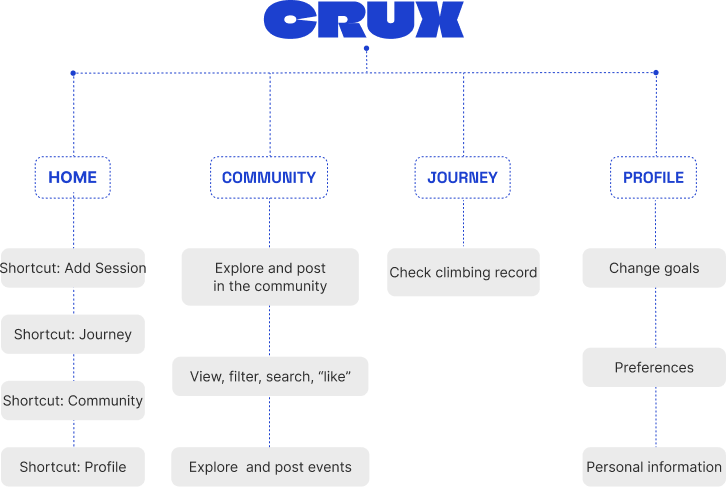
sitemap

CRUX
home
community
journey
profile


Change goals
Preferences
Personal information
Check climbing record
Explore and post in the community
View, filter, search, “like”
Explore and post events
Shortcut: Add Session
Shortcut: Journey
Shortcut: Community
Shortcut: Profile


flowchart


Main menu


Grade
Add new session
Excited
Tired
Holds
Proud
Anxious
Wall angle
Add comment
Save
Frustrated
Afraid
Boulder
Pick emotion
Lead
YES
NO


End:
session saved
low and fidelity


name
WALL TYPE
CRUX HOLDS
attemps
not sent
sent
1
boulder
lead
ubicación
nombre
nombre
hora
hora
likes
comentarios
Finally sent my project! 😄 After weeks on this 7a, it all came together today. Couldn’t have done it without the constant encouragement and spot from my crew. On to the next one!"
Finally sent my project! 😄 After weeks on this 7a, it all came together today. Couldn’t have done it without the constant encouragement and spot from my crew. On to the next one!"
nueva publicación
grid
4
columns
16
gutter
10
margin
foundation
AFFC40
Main color
Main typography

GILROY
24px/ 16 px / 14 px/ regular/ bold
#F1F4F9
Borders
#E2E8F0
UltraLightfonts
#EFEEEE
Lightfonts
#464646
Darktfonts
#191818
UltraDark
#F6F8FC
Background
ui kit
CRUX
climbing app
Not sent
Not sent
Not sent
Not sent
excited
afraid
confident
anxious
frustrated
proud
weak
idk
empathize
define
ideate
prototype
final ui
Place your design here







nereafcastro@gmail.com
check my CV
I’m a UX designer with a curious eye for stories and digital experiences. Looking for my first opportunity to craft designs that make life easier (and prettier). Oh, and I’m also funny and know a bunch of random fun facts. Let’s talk!
home
work
about
Check my master’s final project
As a climber myself, I wanted to enhance the climbing experience through my Master’s final project. I embarked on the journey of designing a dynamic app that helps climbers seamlessly track their sessions, share their progress, and connect with a like-minded community. My goal was to create an engaging and accessible platform that makes indoor climbing more interactive and fosters a stronger sense of connection among climbers.
Type:
Master’s Final Project
Methodology:
Design Thinking
Tools:
Figma
Cateogry:
UX Research and UI Design
empathize
define
ideate
prototype
Problem
Currently, climbing apps face several issues: many have unintuitive interfaces, making them difficult to use; key features are often locked behind paywalls; and users need multiple apps to manage different aspects of their activity, such as maps, training, and connecting with other climbers. This results in a fragmented, confusing, and costly experience, highlighting the need for an all-in-one solution that seamlessly integrates these features into a user-friendly and accessible platform.
Outcome
My solution is Crux, an all-in-one climbing app designed to simplify and enhance the user experience. Crux features an intuitive, user-friendly interface that brings together essential functions such as personalized training plans, progress tracking, and a community of climbers—all in a single platform. With Crux, users can access these tools for free or through a fair subscription, eliminating the need for multiple apps and extra payments. This way, we provide a seamless, efficient, and accessible experience for climbers of all levels
desk research & netnography
As a climber myself, I had firsthand experience with the challenges of using different climbing apps. However, to gain a broader and more objective understanding, I combined desk research and netnography to analyze the landscape of digital tools for climbers. My desk research allowed me to explore existing solutions, industry trends, and the technological gaps in current apps. Meanwhile, through netnography, I studied online climbing communities, forums, and social media discussions to identify common frustrations, expectations, and feature requests directly from users.
Identify the main difficulties climbers face when using existing apps.
Understand how climbers interact with digital tools for training, route planning, and community engagement.
Explore which features climbers find most useful and which ones they feel are missing.
Understand how climbers interact with digital tools for training, route planning, and community engagement.
This combined approach provided a well-rounded perspective on user needs and helped me define key areas for improvement in climbing app experiences.
01
Inintuitive interfaces
Many climbing apps have cluttered or confusing designs, making it difficult for users to navigate and access key features.
02
Usability Issues
Climbers experience frustration with disorganized menus, unclear interactions, and a lack of personalization in existing apps.
03
Features Locked Behind Paywalls
Many apps restrict fundamental functions like route access and progress tracking, forcing users to pay for what they consider essential tools.
04
Fragmented Digital Experience
Users often rely on multiple apps for different needs—one for route mapping, another for training, and another for social connection—leading to a disjointed experience.
05
Technology as a Natural Extension
While climbing is a physical and social activity, digital tools have become part of the experience. The challenge lies in integrating them seamlessly without disrupting the essence of climbing.
research questions
01
What features and functionalities are most valued by climbers in a comprehensive climbing app?
03
How does the ability to connect with other climbers influence users' motivation and performance?
05
How can the app enhance the climbing experience in both indoor and outdoor environments?
07
What role does community feedback play in improving climbing techniques and strategies?
02
What methods for tracking progress and emotions are most effective in helping climbers improve their performance?
04
How can an app support rest and recovery cycles by integrating real-time stats and feedback?
06
How does personalized training planning within the app impact user outcomes?
08
How relevant is the integration of a psychological or motivational support community within the app for climbers?
benchmarking
As part of the research process, benchmarking was conducted to analyze existing climbing apps and identify industry standards, strengths, and gaps in the market. By evaluating competitors, I gained insights into best practices, common pain points, and opportunities for improvement. This comparison helped define key features, usability patterns, and differentiators that would enhance the user experience and provide a more comprehensive solution for climbers.
The application includes the described functionality but does not necessarily stand out in its implementation. In other words, it meets the basic need without offering additional features or significant improvements.

The application does not include the functionality.
Not only does the application provide the functionality, but it does so in an outstanding way, with additional features that enhance the user experience. This feature is well-designed, intuitive, and exceeds expectations.
Top loger
Bumble
Mountain Project
Redpoint
Vertical Life
Cling
27 Crags
Kaya Climb
The Crag
La Pirca
Clarity and usability of the interface
Detailed tracking of achievements and training sessions
Social features for finding climbing partners
Adaptive workout programs based on user level and goals
Physical and emotional state tracking
Active community for user interaction and knowledge sharing


The comparative analysis of existing climbing applications reveals that, while many offer interesting features such as climbing logs and training programs, none integrate all these functionalities into a single platform. Additionally, only one of the evaluated apps allows users to record mood or feelings, which could be key to a more personalized approach. Many users also report recurring issues with the user interface and the lack of an active community, limiting the app’s usefulness. This highlights a clear opportunity to develop an application that seamlessly combines these features, promoting both personal progress tracking and climber connectivity, with a strong focus on safety and community-driven motivation.
swot
needs
All-in-One Tool
Combines achievement tracking, training logs, and social features.
User-Friendly
Intuitive navigation enhances the experience.
Affordable
Free or low-cost, making it widely accessible.
Insurance Card Scanning
Builds trust by ensuring that users are responsible
Community-Driven
Encourages interaction and a sense of belonging.
Personalized Training
Tracks mood and injuries for mindful progress.
weakness
Strong Competition
Several well-established apps in the market offer similar functionalities.
Limited Resources
As a new app, it may lack the user base and content of more established competitors.
Revenue Dependence
If the app is free or low-cost, it may face financial challenges in sustaining development and long-term operations.
opportunities
Growing Interest in Climbing
Increasing popularity, especially in urban settings and climbing gyms.
Partnership Opportunities
Potential collaborations with climbing gyms to promote the app.
Technological Innovations
Integration of new technologies, such as augmented reality, to enhance the user experience.
Demand for Affordable Apps
The rising interest in climbing presents an opportunity to attract users seeking budget-friendly alternatives to expensive apps
threats
Shifting Trends
Fluctuations in climbing popularity could impact app usage
Competition from Facebook Groups
These groups are a popular way to find climbing partners, potentially reducing app engagement.
Financial Sustainability
Offering the app for free or at a low cost may risk insufficient revenue to cover operational expenses, threatening service continuity and future improvements.
qualitative research
To better understand user needs and expectations, I conducted interviews with men and women aged 20 to 40, with varying levels of climbing experience and different technology usage habits. Additionally, five of them were immigrants living in a foreign country, which allowed me to explore how climbing helps with social adaptation and building a sense of community in a new environment. These interviews provided valuable insights into their motivations, challenges, and preferences, enabling me to design a solution that truly aligns with their real needs
Number of
interviews
7
interviews have been conducted
01
Through the interviews, I identified several key pain points faced by indoor climbers. One of the main challenges is the need to use multiple apps to manage their activity, as there is currently no platform that integrates essential features like community building, climb tracking, and finding partners in one place. Additionally, many users expressed frustration over paid content restricting access to fundamental features in other climbing apps.
02
Another key finding is that 90% of interviewees believe their emotional state significantly impacts their climbing performance, highlighting the importance of having a supportive community. Additionally, several participants, especially women, mentioned that they stopped climbing due to the lack of climbing partners, emphasizing the need for a solution that facilitates connections among climbers.
03
On the other hand, all interviewees agreed that they trust climbers with a certified insurance card, considering it a key factor for safety. Lastly, they highlighted that seeing other climbers' achievements serves as a major source of motivation and learning, helping them continuously improve their skills.
quantitative research
empathize
define
ideate
prototype
persona
Célia Pérez, 22
Aragón, Spain
Sports Science Student
High use of technological devices., apps and social media
Celia, 22, from Aragón, is a fourth-year Sports Science student and a passionate indoor climber with over a decade of experience. Her main goal goes beyond enjoying climbing: she wants to improve her performance and push her limits.
She applies her academic knowledge to training, carefully tracking every session to analyze progress and challenges—especially as improvements slow at higher levels. Currently, she relies on multiple apps, but none fully meet her needs. She is looking for a single tool that allows her to log climbs, attempts, progress, and areas for improvement in an indoor climbing context.
Additionally, Celia wants to share her routines and insights with the climbing community and learn from others to keep improving in the sport she loves.
needs
A tool to track progress, including routes, attempts, and improvements.
A platform to maintain training consistency and visualize progress
Features to share achievements and learn from others.

frustrations
Slow progress at advanced levels.
No comprehensive app for indoor climbing tracking.
Lack of an all-in-one logging and collaboration tool.
motivations
Driven by skill improvement and reaching new challenges.
Applies Sports Science knowledge to enhance performance.
Engaged in contributing to and learning from the climbing community.

goals
Keep a detailed training log.
Add technical data based on her academic knowledge.
Connect with other climbers to share experiences and routines.
interests
Progressing as a climber
Keeping a record of her training sessions
Engaging in collaborative learning within the climbing community
empathy map
costumer journey map
needs matrix
needs
Logging of climbing routes and achievements, both indoor and outdoor.
Social features (sharing achievements, connecting with friends).
Belayer verification to build trust within the community.
Option to log physical and mental state after sessions.
Functionality to find reliable climbing partners.
pains
Difficulty finding climbing partners in a new location.
Difficulty tracking and monitoring injuries or specific physical conditions.
Concerns about safety when climbing with strangers.
Lack of platforms that combine progress tracking with social features.
gains
Ease of maintaining a detailed and organized climbing history.
Motivation through progress tracking and friends' achievements.
Increased safety knowing that belayers are accredited.
A trustworthy environment to meet verified climbers.
Ability to monitor physical performance and avoid movements that cause pain.
finding and insights
01
Need for Integration
Climbers seek an all-in-one app that includes training, route logging, progress tracking, and connection with other climbers, as current options are fragmented.

A
All-in-One App
A single platform combining training, route tracking, social connection, and physical progress monitoring would fill a significant gap in the market.
02
Motivation Through Progress
Users value tracking their progress over time, especially when improvement is slow. Detailed logging tools help maintain motivation.

B
Autonomy and Privacy Control
Allowing users to choose what information to share and what to keep private will increase adoption, especially among more reserved users.
03
Safety Concerns
Trust and safety are key factors, both in terms of belayers and verifying climbing partners. Social media alone is not enough to establish this trust.

C
Community Safety
Implementing features to verify climbers' skills and belaying certifications can enhance trust and security.
04
Physical Pain and Prevention
Climbers of all levels appreciate the ability to log injuries and track their physical condition to prevent future issues or improve technique.

D
Motivational Elements
ncluding detailed analytics and small achievements, such as badges or visual progress summaries, can help maintain long-term motivation, especially for advanced climbers facing slower progress.
05
Social Interaction and Community
Many climbers look for a simple and safe way to find climbing partners, especially when in a new city or community, without relying on traditional social media.

E
User Connection and Learning
Creating a climbing community where users can share experiences, routines, and tips can provide continuous motivation and learning opportunities.
business model canvas
key partners
Climbing brands: Product collaborations.
Climbing gyms: App promotion and usage.
Climbing influencers: For marketing and promotion.
key activities
App development and maintenance: Ongoing updates and improvements.
User research and feedback analysis – Understanding user needs to improve features and usability.
Marketing and promotion: User acquisition and community building.
Content creation: Guides and training materials.

costumer segments
Beginner climbers: Looking to learn and improve.
Experienced climbers: Want to track their progress and connect with others.
Indoor climbing enthusiasts: Need tailored training.

key resources
Software developers: To build and maintain the app.
Climbing experts: For content and training guidance.
Technology infrastructure: Servers and databases.
value proposition
Comprehensive climbing app: Training log, connection with other climbers, and progress analysis.
Climbing gyms: App promotion and usage.
Personalized features: Training suggestions and a supportive community.
costumer relationships
Customer support: In-app assistance.
Online communities: Forums and groups to share experiences.
Personalized training: Routine-related consultations.
Email updates and newsletters – Sharing new features, tips, and climbing content.
cost structure
Software development and maintenance: Operational costs of the app.
Marketing: Advertising and promotion expenses.
Customer support: Resources to maintain user relationships.
revenue stream
Personalized features: Training suggestions and a supportive community.
Paid courses or personalized training plans
Premium subscription with advanced features
channels
App stores (Google Play, App Store)
Social media (Instagram, Facebook, TikTok)
Collaborations with climbing gyms
Climbing events and competitions
empathize
define
ideate
prototype
sitemap
CRUX
home
community
journey
profile
Change goals
Preferences
Personal information
Check climbing record
Explore and post in the community
View, filter, search, “like”
Explore and post events
Shortcut: Add Session
Shortcut: Journey
Shortcut: Community
Shortcut: Profile
flowchart


Main menu


Grade
Add new session
Excited
Tired
Holds
Proud
Anxious
Wall angle
Add comment
Save
Frustrated
Afraid
Boulder
Pick emotion
Lead
YES
NO


End:
session saved
low and high fidelty


name
WALL TYPE
CRUX HOLDS
attemps
not sent
sent
1
boulder
lead
ubicación
nombre
nombre
hora
hora
likes
comentarios
Finally sent my project! 😄 After weeks on this 7a, it all came together today. Couldn’t have done it without the constant encouragement and spot from my crew. On to the next one!"
Finally sent my project! 😄 After weeks on this 7a, it all came together today. Couldn’t have done it without the constant encouragement and spot from my crew. On to the next one!"
nueva publicación
grid
4
columns
16
gutter
10
margin
foundation
AFFC40
Main color
Main typography

GILROY
24px/ 16 px / 14 px/ regular/ bold
#F1F4F9
Borders
#E2E8F0
UltraLightfonts
#EFEEEE
Lightfonts
#464646
Darktfonts
#191818
UltraDark
#F6F8FC
Background
ui kit
CRUX
climbing app
Not sent
Not sent
Not sent
Not sent
excited

afraid
confident
anxious
frustrated
proud
weak
idk
empathize
define
ideate
prototype
final ui

Place your design here
nereafcastro@gmail.com
check my CV
I’m a UX designer with a curious eye for stories and digital experiences. Looking for my first opportunity to craft designs that make life easier (and prettier). Oh, and I’m also funny and know a bunch of random fun facts. Let’s talk!